Based on the unforgettable memoir that exposed the inner workings of slavery in the 19th Century, comes ’12 Years A Slave,’ director Steve McQueen’s (Hunger, Shame) mesmerizing and incredibly moving account of New York family man Solomon Northup’s (Chiwetel Ejiofor) unexpected kidnapping, his dizzying journey into Louisiana’s slave plantations, and his unbreakable quest to get home to those he loves.
In the pre-Civil War United States, Solomon Northup, a free black man from upstate New York, is abducted and sold into slavery. Facing cruelty (personified by a malevolent slave owner, portrayed by Michael Fassbender), as well as unexpected kindnesses, Solomon struggles not only to stay alive, but to retain his dignity. In the twelfth year of his unforgettable odyssey, Solomon’s chance meeting with a Canadian abolitionist will forever alter his life. Opening on October 18th in the US and January 24th in the UK, ’12 Years a Slave’ also stars Brad Pitt, Lupita Nyong’o, Alfre Woodard, Paul Dano, Benedict Cumberbatch, Ruth Negga, Adepero Oduye, Paul Giamatti, Garret Dillahunt, Sarah Paulson, Scoot McNairy, Dwight Henry, Quvenzhané Wallis, and Michael Kenneth Williams.

What was your initial thoughts on how you would play Edwin Epps, a Louisiana slave owner who reveals himself to be a haunted, drunken man whose fury is set off by Northup’s unbeaten spirit? I read that the real Epps had such a reputation for reprehensible behavior that to this day locals in Louisiana still admonish with the phrase “stop being Epps…”
Michael Fassbender: Yeah. When I spoke to Steve right at the beginning about undertaking the character, he was like, “What do you think about him?” I replied, “Well, I kind of see him as a result of the time, you know?” I didn’t see him as an individual monster, although we could have easily gone down that path. I said that the fact that he was in love with Patsey, one of his slaves, was a big deal, and he said, “Exactly.” And that was the centerpiece of the whole thing, the fact that he’s in love and the fact that he doesn’t have the intellect or capability to process that, so he sets about destroying her. I thought that was a very interesting conflict and a very human conflict.
He’s a human being, so I approached him with a very human touch. I tried to find his voice first. I worked with a lot of different tapes and our dialect coach helped me out a lot. And then I just spent a lot of time with the script. It was about finding the human being in Epps, because obviously what he does is pretty terrible, but… I don’t know, there’s something in there where I feel a little sorry for him. He’s a victim of the time as well, in a way. He’s in love with Patsey and he can’t deal with it, he thinks, “How can I be in love with a slave?” So he sets about suppressing her and beating her to try to beat it out of himself. So I thought that there was a really amazing humanity in that alone. So that was my in: the love for Patsey and how he was processing that.
The human connection….
Michael Fassender: Yeah, I’m interested in finding the human connection, especially in a story like this – because slavery is a complex topic. It was a complex time in history and it’s not like a simple “master and slave” dynamic, there’s many things. There are so many things going on because we’re human beings, even though a large group of people acted incredibly inhumane at that time. You know…. what’s it like to lash another human being 150 times or 100 times or 50 times, whatever it may be. Of course we know that getting lashed 50 times will be horrendous, but what’s it like to go home with that muscle memory everyday, and to go home with that psychological memory everyday. I tried to approach the character like that, and that was me and Steve’s outlook from the beginning. We tried to look at it very grey, which is difficult when you think about Epps. Human beings are complicated and life is complicated, we’re not trying to preach, we’re trying to investigate and shine a light and probe some questions.
You have a sort of responsibility to the piece to get under his skin…?
Michael Fassbender: Yeah, there’s a responsibility to play the character as a human being as opposed to me standing outside of him going, “God, Epps is a terrible person, I’m going to portray a terrible person.” I’ve got to try to understand him and try to get under his skin and do it to the best of my ability. His love of Patsey was something that Steve and I had talked about right at the beginning. Steve would always quiz me, “So, what do you think about Epps?” For me he was a tragic character because he’s in love with Patsy and he couldn’t process that love and he didn’t know what to do with it.
I thought he was a real combination of all the ugliness of that time and the slave trade…. all in this human being that I could represent. He’s like a boil on the skin of the society at the time. And I guess looking at him like that and trying to find a human being it helps you avoid becoming a clichéd evil slave owner or landowner. It was important to find a human being so that audience members – even as horrendous as he is at times – they recognize something in him. They can see something in him that they recognize, and I think that’s more effective. I think I see Epps as a representative of the time, all the ugliness and despicableness is culminated into this character.
It’s always the same sort of process for me. I go over the scenes trying to find what parts of the story reveal certain aspects of the character. What’s he searching for? Is there a root to this sort of violence? How do you relate to people if in your mind they are somehow seen as subhuman? When you are bringing pain to people every day how does that then affect you, and your muscle memory, and how do you carry that around? I saw a constant tug of war going on within Epps.
What was your initial draw to this story and the character of Epps? He has very interesting dynamics with Solomon and Patsey, in particular.
Michael Fassbender: It’s an important story to tell, to look at the history of what we human beings are capable of doing to one another. I was very moved by this story. It shows the complexity of slavery and all the different facets of slavery – which perhaps hasn’t been investigated before in film. It shows the economy of slavery, we see Solomon go from a logging farm to a cotton farm, to sugar canes – so we see how intrinsic it was to the economy of the time in the South. And we see the complexity of the relationships, you know? I think 65% of black Americans have got white blood in them, so that just shows you how endemic rape was.
As I began to explore what drives Epps, I began to see that at heart, he is both confused and affronted by Northup. In a farming world where little is certain, Epps has come to find a certain personal sense of control in his cruelly paternal, dictatorial relationship with his slaves, but Northup defies that, even if in subtle ways. And I think because Solomon is of greater intelligence than Epps, and Epps perhaps doesn’t even have the intelligence to suss that out. But there is something about Solomon he feels threatened by. He knows there’s something at play that he can’t put his finger on. He feels inadequate when he’s around him, which I think is very much at the root of their relationship. For Solomon, it is a constant dance with an unpredictable and violent man.
Epps is obsessed with Patsey, and that’s information he can’t process, he can’t live with. For Mistress Epps it’s doubly frustrating because everyone on the plantation knows. But for Patsey, it’s horrific because she gets it from Epps and Mistress Epps. Patsey is basically at their mercy and they’re not very merciful people. And Patsey has a special energy as a person, she’s incredibly graceful – even in these extraordinary circumstances she still has this sort of magnificence about her in terms of her poise, her pride and her work. I think Lupita is perfect in that role.
What was the experience like acting opposite the likes of Chiwetel and Lupita, especially in the more challenging scenes and considering the way Steve shoots with complete takes?
Michael Fassbender: You’re only as good as the person standing opposite you, especially when you’re doing a film like this. There was a lot of love on set and a lot of support and provoking each other and challenging each other, but at the end of the day supporting one another and looking after one another – and that’s down to Steve, he creates that environment. It’s a very trusting environment and safe environment to create. It’s important to fall on your face a few times. When you don’t have the support railings that you do on a lot of films, with coverage shots and short takes, which makes it literally acting by numbers – this is the real deal.
Chiwetel is obviously incredibly experienced and a great actor, I’ve been a fan of his work for a long time. He and Lupita are magnificent in this movie. And both of them were very reactive in the scenes, and with filming with Steve being very fluid and fast and intuitive, everybody has to be tapped in. And thankfully the whole cast was. It makes it so much more challenging and enjoyable when you’ve got your fellow actors provoking you and testing you and supporting you.
With Steve you have complete takes, and when that’s happening, it’s like music. There’s rhythms there, you have to dance with the cameraman, Sean Bobbitt, and with the fellow players. If the rhythm’s out, you feel it, you see it. But if it’s in sync, then something special happens. You surprise yourself. You go to places that you didn’t imagine you would. It requires a lot of commitment and focus, and if one of us wasn’t committing to the other something drops, something falls apart. It was amazing working with the cast on ’12 Years a Slave,’ such an amazing cast.
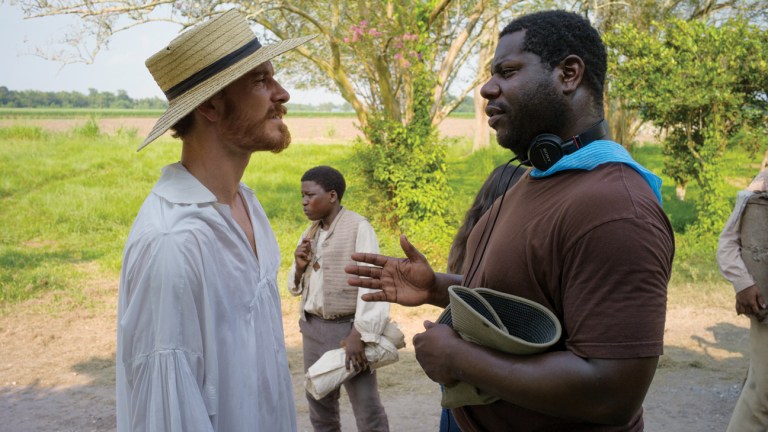
You’ve starred in all of Steve McQueen’s three feature films. How is it working with him on set? Just being around you two you can see there’s a bond there….
Michael Fassbender: It’s painful (laughs). But really, it’s just an incredibly special experience working with Steve. From the beginning of my career I’ve been seeking, looking for somebody like Steve – somebody who will bring the best out of you and take you to the limit of yourself and then beyond it, and then maintain that level of beyond the limit… if that makes sense (laughs). The focus on set is incredible, and not just with the cast but with the entire crew. There’s just this sort of absolute do or die philosophy on set. It’s just amazing, One of the many great things about Steve is that he allows you to believe in your instincts, and so whatever choice you make is the right choice, because you’re in the right moment.
With the prep there’s so much attention and care and love, which is important with these difficult stories he tells. It wouldn’t have been possible without the real sense of love and connection on set. Everyone involved on the set was linked to one another, and without one another we wouldn’t have gone to the heights that we got to. I think it was total dependence on one another, and Steve’s the head of that.
Steve is just very good with human beings and he’s very good in understanding human behavior. He has a curiosity with it for sure, and he approached it in a very non-judgmental way. He’s very good with people, he knows how to motivate people and he’s passionate about what he’s doing – and he expects that from everyone else. He demands a lot but he’s also very nurturing and very encouraging. He allows you to feel confident in your instincts, and that is in all departments. He’s really a fantastic leader, and he inspires each department in a way that I think comes across on screen.
With ‘Hunger,’ ‘Shame’ and now ’12 Years a Slave,’ you play three very different characters. I can imagine that they were all challenging in there own rights for a variety of reasons, but was there one in particular that you found the most difficult?
Michael Fassbender: For me it’s apples and oranges, they were all challenging pieces for different reasons. I think they’re challenging for the audience as well, which is a great thing. With Steve’s films, as an audience member you have to contribute, it’s not a passive experience in any respect. They all had their levels of challenge to them, but I have to say that with this one here the support of this large cast made it a lot easier. Together we looked after each other and supported each other. And Steve’s very demanding, that’s for sure. He expects everything of everyone, not just the actors, but the crew as well and also himself. But I love working with him it because I just know that working with him is always a very special experience and a very great learning experience. I learn so much working with him.
 The Artsy Film Blog